New Jersey, USA


Introduction
Successful dental restorations begin long before treatment starts. Whether planning a single crown, a full-mouth rehabilitation, or an implant-supported restoration, every successful outcome depends on careful preparation. This is where dental case planning becomes essential.
Effective dental case planning allows clinicians and dental laboratories to evaluate clinical conditions, identify potential challenges, and create a treatment strategy that improves accuracy, aesthetics, and long-term success. By following a structured planning process, dental professionals can minimize complications, improve communication, and deliver more predictable results.
This step-by-step guide explains the complete dental case planning process and highlights the key factors that contribute to successful restorative treatments.
What Is Dental Case Planning?
Dental case planning is the process of evaluating all clinical, functional, and aesthetic aspects of a patient’s treatment before any restorative procedure begins.
The planning process involves collaboration between:
- General dentists
- Implant surgeons
- Prosthodontists
- Orthodontists (when required)
- Dental laboratory technicians
The goal is to design a restoration that provides optimal function, aesthetics, and long-term durability.
Step 1: Patient Consultation
Every case begins with a detailed consultation.
During this appointment, clinicians evaluate:
- Chief complaint
- Medical history
- Dental history
- Patient expectations
- Functional concerns
- Aesthetic goals
Understanding the patient’s expectations helps guide every stage of treatment planning.
Step 2: Clinical Examination
A comprehensive oral examination provides valuable diagnostic information.
The clinician should assess:
- Existing restorations
- Tooth condition
- Soft tissue health
- Periodontal status
- Occlusion
- Missing teeth
- Wear patterns
This evaluation helps identify potential complications before treatment begins.
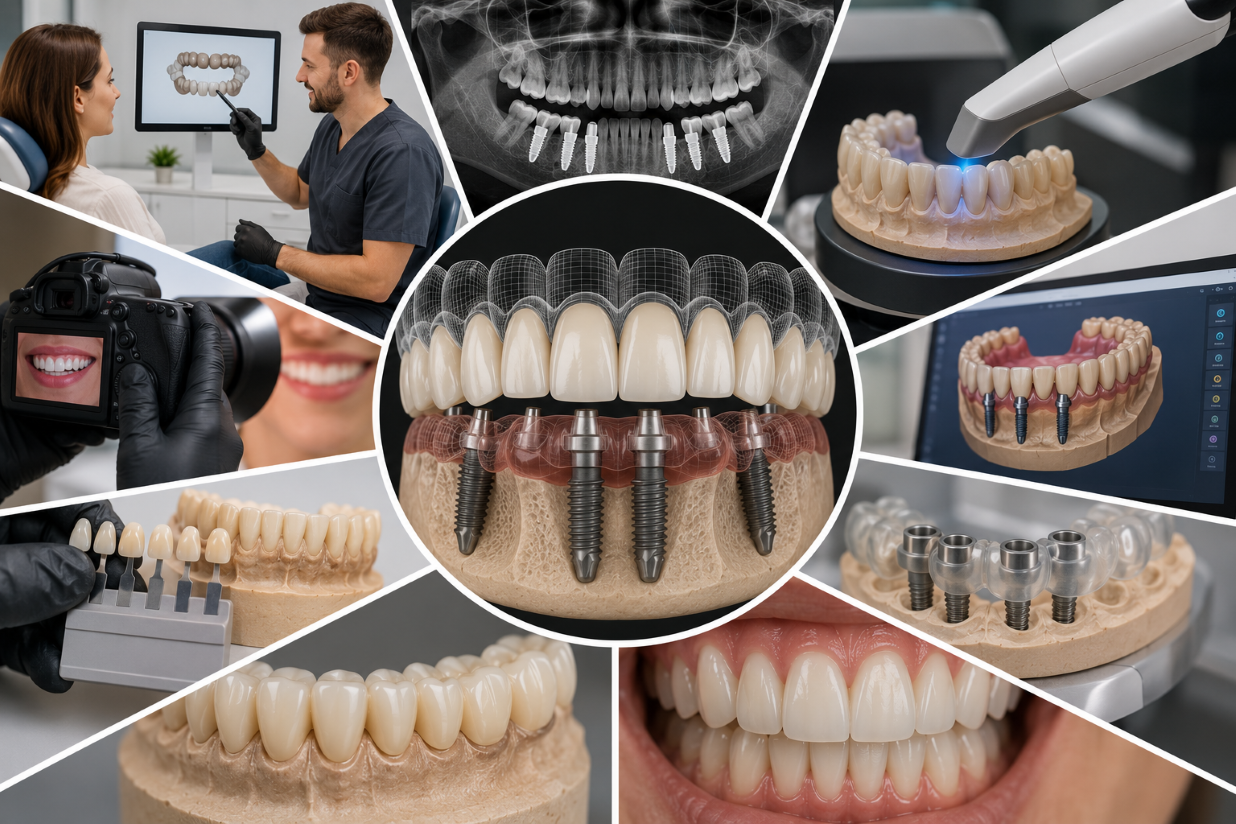
Step 3: Digital Imaging and Diagnostics
Modern digital technology has significantly improved treatment planning.
Common diagnostic tools include:
Cone Beam Computed Tomography (CBCT)
Provides detailed three-dimensional information about bone anatomy and implant sites.
Intraoral Scanners
Capture highly accurate digital impressions for restorative planning.
Digital Photography
Helps document smile characteristics and improve laboratory communication.
Digital Smile Design
Allows clinicians to visualize the final treatment outcome before fabrication begins.
These technologies improve accuracy while simplifying collaboration between clinics and dental laboratories.
Step 4: Diagnosis and Treatment Objectives
After collecting diagnostic information, clinicians establish a definitive diagnosis and define treatment goals.
Objectives may include:
- Restoring function
- Improving aesthetics
- Replacing missing teeth
- Correcting occlusion
- Preserving healthy tooth structure
- Enhancing patient comfort
Clear treatment objectives ensure that every clinical decision supports the desired outcome.
Step 5: Material Selection
Choosing the appropriate restorative material is a critical part of dental case planning.
Common materials include:
- Zirconia
- Lithium disilicate
- Composite resin
- PMMA
- Titanium frameworks
- Hybrid prosthetic materials
Material selection depends on:
- Restoration location
- Bite force
- Aesthetic requirements
- Implant support
- Patient expectations
Selecting the right material improves restoration longevity and performance.
Step 6: Prosthetically Driven Treatment Planning
Restorations should guide implant placement—not the other way around.
Important considerations include:
- Implant positioning
- Emergence profile
- Occlusion
- Vertical dimension
- Smile line
- Soft tissue support
Prosthetically driven planning ensures that the final restoration is both functional and aesthetically pleasing.
Digital planning software greatly improves precision during this stage.
Step 7: Collaboration with the Dental Laboratory
Successful restorative treatment depends on strong communication between clinicians and dental laboratories.
Laboratory technicians assist with:
- CAD design
- Restoration design
- Material recommendations
- Surgical guide fabrication
- Shade verification
- Quality control
Sharing digital impressions, photographs, CBCT scans, and treatment notes allows technicians to produce highly accurate restorations.
Collaboration is one of the most valuable aspects of dental case planning.
Step 8: Provisional Restorations
Temporary restorations allow clinicians to evaluate:
- Function
- Occlusion
- Aesthetics
- Phonetics
- Patient comfort
Adjustments made during the provisional phase can improve the design of the final restoration.
This stage is particularly valuable in full-mouth rehabilitation and implant cases.
Step 9: Final Restoration Fabrication
Once all planning stages are complete, the dental laboratory manufactures the final restoration using CAD/CAM technology or other advanced fabrication techniques.
Before delivery, restorations undergo quality control to verify:
- Marginal fit
- Occlusion
- Contacts
- Shade accuracy
- Surface finish
High manufacturing standards improve clinical success and patient satisfaction.
Step 10: Delivery and Long-Term Maintenance
Treatment does not end when the restoration is delivered.
Clinicians should provide patients with instructions for:
- Daily oral hygiene
- Professional maintenance
- Regular examinations
- Occlusal monitoring
- Implant maintenance (when applicable)
Routine follow-up appointments help preserve both the restoration and surrounding oral tissues.
Long-term maintenance is essential for maximizing restoration longevity.
Common Case Planning Mistakes
Effective planning helps avoid common restorative complications such as:
- Poor implant positioning
- Inadequate material selection
- Incorrect occlusal design
- Insufficient communication
- Inaccurate digital impressions
- Incomplete patient evaluation
Following a structured workflow significantly reduces these risks.
The Future of Dental Case Planning
Digital dentistry continues to improve planning accuracy through innovations such as:
- Artificial intelligence-assisted treatment planning
- Advanced facial scanning
- Cloud-based laboratory collaboration
- Digital smile simulation
- Automated CAD design
- Enhanced surgical guide technology
These technologies make restorative treatments more predictable, efficient, and patient-centered.
Conclusion
A structured approach to dental case planning is the foundation of successful restorative dentistry. From patient consultation and digital diagnostics to laboratory collaboration and final delivery, every step contributes to predictable clinical outcomes.
By following a comprehensive workflow, clinicians and dental laboratories can improve communication, reduce complications, and create restorations that meet the highest standards of function, aesthetics, and durability. As digital dentistry continues to evolve, dental case planning will remain one of the most important factors in achieving long-term restorative success.