New Jersey, USA


Introduction
Choosing the right retention method is an important part of implant restoration planning. Two of the most common options are screw-retained and cement-retained crowns. Each approach has different advantages, limitations, and clinical considerations.
Understanding the differences between screw-retained vs cement-retained implant crowns helps clinicians and dental laboratories select the most appropriate solution based on implant position, aesthetics, retrievability, and long-term maintenance.
This article compares screw-retained vs cement-retained implant crowns and explains the key factors involved in choosing the right option.
What Are Screw-Retained Implant Crowns?
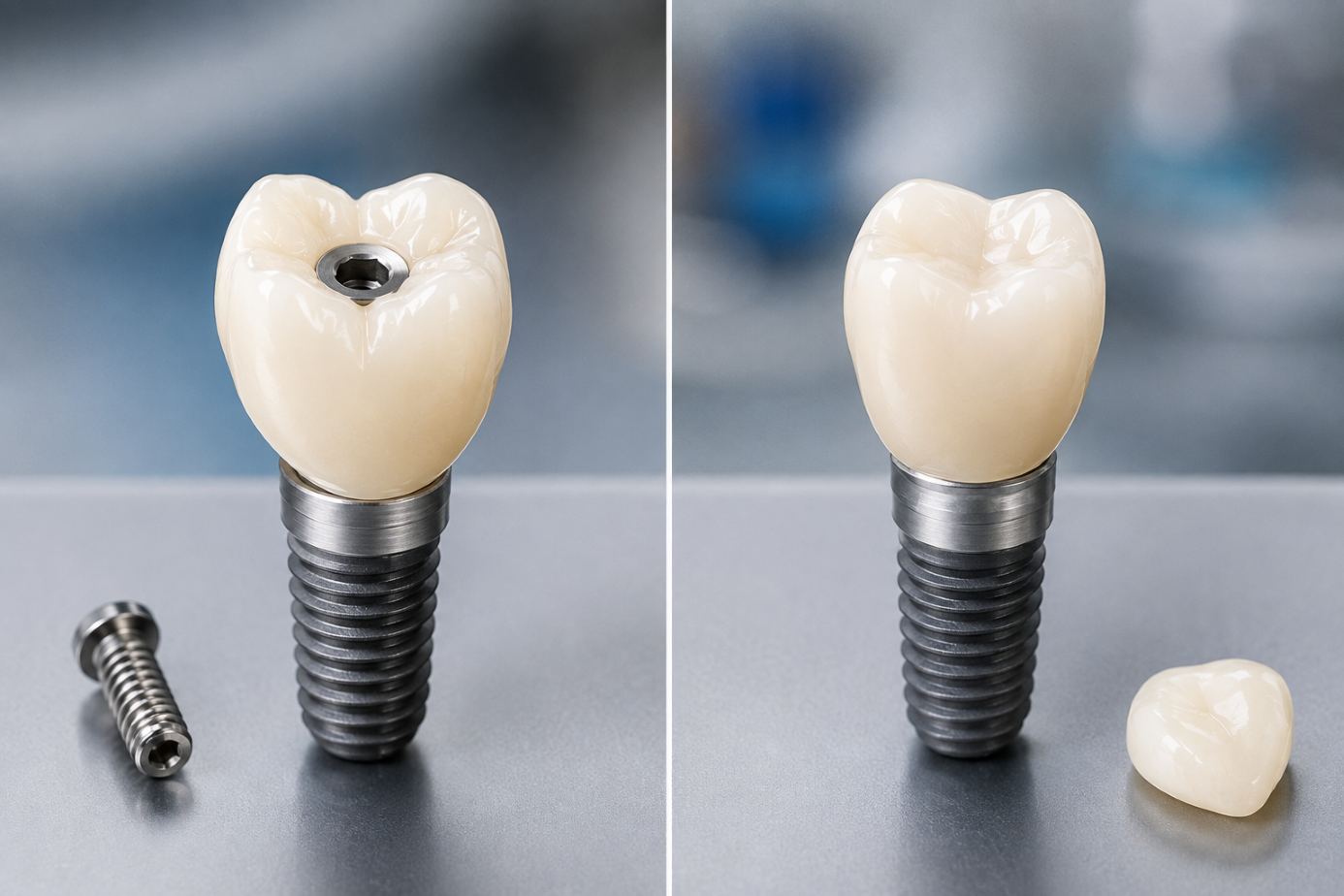
A screw-retained crown is attached directly to the implant or abutment using a prosthetic screw. The restoration can be removed when necessary by accessing the screw through an opening in the crown.
Advantages of Screw-Retained Crowns
- Easy retrievability for maintenance or repairs
- No risk of excess cement around the implant
- Simplified removal when complications occur
- Suitable for many single-tooth and full-arch restorations
- Useful for long-term maintenance
The ability to remove the restoration is one of the main advantages of screw-retained designs.
Limitations of Screw-Retained Crowns
The screw access channel may create aesthetic or functional challenges, particularly when the implant is positioned unfavorably.
Potential limitations include:
- Visible access holes in some anterior cases
- Reduced aesthetic flexibility
- Dependence on appropriate implant angulation
- Possible complications such as screw loosening
Modern materials and angled screw channel systems can help manage some of these challenges.
What Are Cement-Retained Implant Crowns?
Cement-retained crowns are attached to an implant abutment using dental cement, similar to many conventional crown restorations.
This approach can offer greater flexibility when implant angulation makes screw access less desirable.
Advantages of Cement-Retained Crowns
- No visible screw access hole
- Potentially improved aesthetics in selected cases
- Greater flexibility for certain implant positions
- Familiar workflow for many clinicians
Cement-retained restorations may be useful when achieving an ideal screw access position is difficult.
Limitations of Cement-Retained Crowns
One of the main concerns is the possible retention of excess cement around the implant restoration. Residual cement may contribute to complications in surrounding tissues.
Other limitations include:
- More difficult retrieval
- Potential damage during removal
- Greater dependence on proper cementation protocols
- Challenges during repairs or maintenance
Careful cement control and proper abutment design are essential.
Key Differences Between the Two Options
| Feature | Screw-Retained | Cement-Retained |
|---|---|---|
| Retrievability | Easy to remove | More difficult to remove |
| Excess cement risk | No cement required for retention | Requires careful cement control |
| Aesthetics | Screw access may affect appearance | No screw access hole |
| Implant angulation | More dependent on access position | Can offer more flexibility |
| Maintenance | Generally easier | May be more challenging |
| Repairs | Usually easier to manage | Removal may be more difficult |
The Importance of Implant Position
The position and angulation of the implant play a major role in selecting the retention method.
Ideally, implant placement should be planned prosthetically before surgery. When the implant is positioned correctly, a screw-retained restoration can often provide both functional and aesthetic benefits.
However, if the screw access channel would emerge in an undesirable location, a cement-retained design or an angled screw channel may be considered.
This is why communication between the surgeon, restorative dentist, and dental laboratory is essential during treatment planning.
Aesthetic Considerations
Aesthetic demands are particularly important in the anterior region.
For screw-retained crowns, the location of the access channel can affect the appearance of the restoration. Modern composite materials can be used to close the access opening, but its position should still be considered during planning.
Cement-retained crowns eliminate the access hole, which can offer advantages in selected aesthetic cases.
However, aesthetics should always be balanced with long-term maintenance and biological considerations.
Maintenance and Long-Term Care
Implant restorations require regular monitoring and maintenance.
One major advantage of screw-retained crowns is retrievability. The restoration can usually be removed for:
- Screw replacement
- Component inspection
- Cleaning
- Repair
- Prosthetic adjustments
Cement-retained crowns may require more complex removal procedures when maintenance is necessary.
For this reason, retrievability is an important consideration when comparing screw-retained vs cement-retained implant crowns.
The Role of the Dental Laboratory
The dental laboratory plays an important role in designing both types of implant restorations.
Technicians must consider:
- Implant system compatibility
- Abutment design
- Restoration thickness
- Screw channel position
- Material selection
- Occlusion
- Contact points
- Emergence profile
Digital planning and CAD/CAM technology allow laboratories to evaluate these factors before manufacturing begins.
Close communication between the laboratory and clinic helps reduce complications and improves the predictability of the final restoration.
Which Option Is Better?
There is no single solution that is ideal for every patient.
The choice depends on several factors, including:
- Implant position and angulation
- Location of the restoration
- Aesthetic requirements
- Available restorative space
- Occlusal forces
- Need for future maintenance
- Prosthetic design
In many cases, screw-retained restorations are preferred because of their retrievability and the absence of residual cement. However, cement-retained crowns can still be appropriate in selected clinical situations.
Conclusion
The decision between screw-retained and cement-retained implant crowns should be based on careful prosthetic planning rather than a one-size-fits-all approach. Implant position, aesthetics, maintenance requirements, and restoration design all influence the final choice.
When comparing screw-retained vs cement-retained implant crowns, close collaboration between the clinician and dental laboratory is essential. A well-planned restoration can improve retrievability, aesthetics, function, and long-term success.
Both options can provide successful outcomes when they are selected and designed according to the specific requirements of the case.