New Jersey, USA


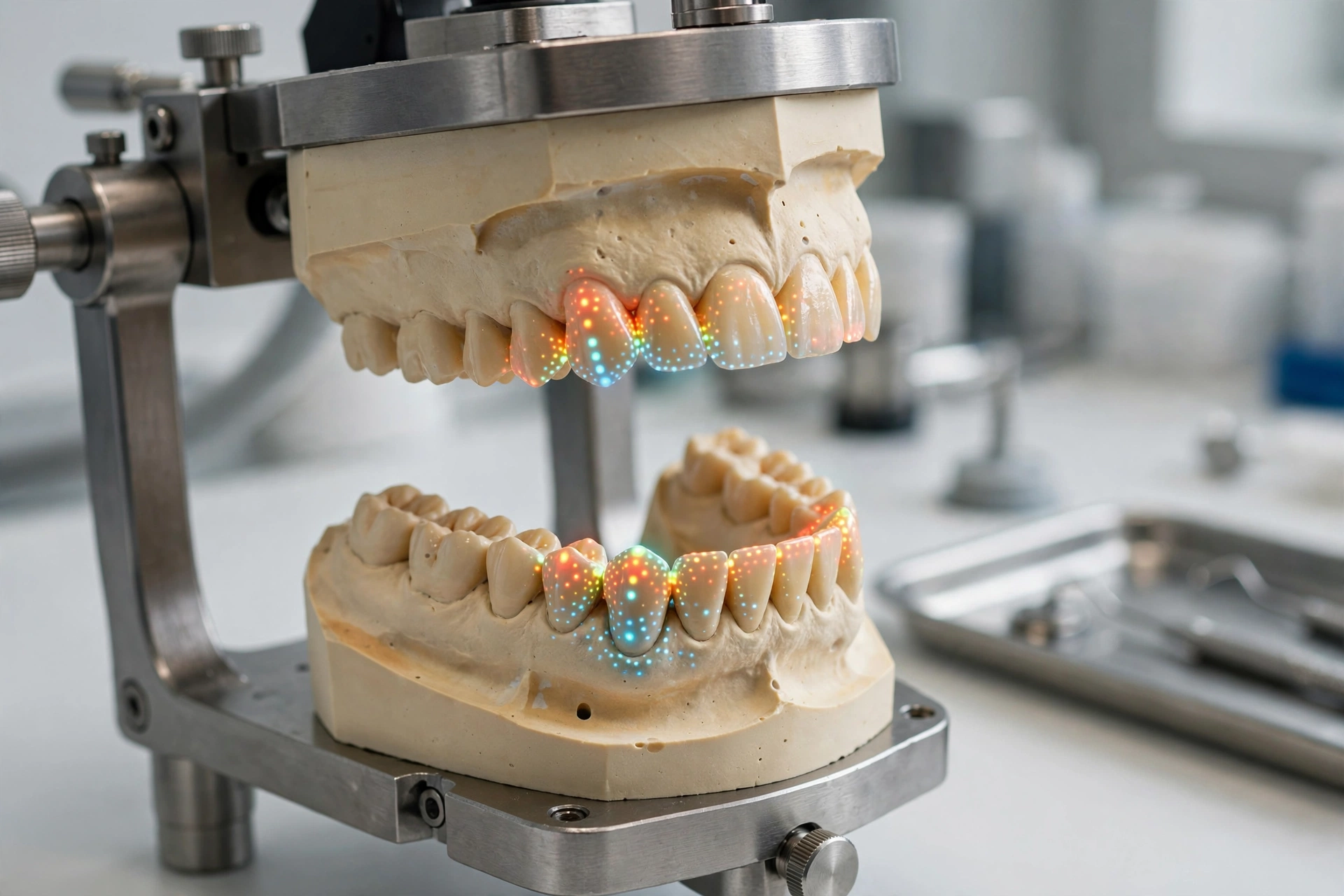
A successful dental restoration requires more than accurate impressions and high-quality materials. The restoration must also function harmoniously with the patient’s existing dentition. Understanding how the upper and lower teeth interact during biting, chewing, and movement is essential for achieving predictable functional and aesthetic results.
For dental laboratories, occlusion is an important part of the restoration design process. Accurate records, digital workflows, articulator analysis, and close communication with the dentist can help technicians create restorations that integrate more naturally into the patient’s bite.
What Is Occlusal Analysis?
Occlusal analysis is the evaluation of how the teeth contact and function against each other. It can help identify premature contacts, uneven force distribution, interferences, and discrepancies between the planned restoration and the patient’s functional bite.
Depending on the case, dental professionals may evaluate static contacts as well as dynamic mandibular movements. Bite registrations, intraoral scans, photographs, articulators, and digital design software can all contribute to a more complete understanding of the patient’s occlusal relationship.
For dental technicians, this information provides valuable guidance when designing crowns, bridges, veneers, implant-supported restorations, and full-mouth rehabilitation cases.
Why Occlusion Matters in Dental Restorations
Even a restoration with excellent marginal fit and aesthetics can create functional problems if its occlusal contacts are inaccurate.
An incorrectly designed restoration may contribute to:
- Premature contacts
- Difficulty when biting or chewing
- Uneven distribution of occlusal forces
- Increased adjustment appointments
- Chipping or fracture of restorative materials
- Patient discomfort
- Increased risk of restoration failure
For this reason, occlusal considerations should be incorporated into the restoration workflow rather than treated as a final adjustment step.
How Dental Laboratories Evaluate Occlusion
The laboratory can use several sources of clinical information to understand the patient’s bite.
Bite Registration
An accurate bite record helps establish the relationship between the upper and lower arches. If the record is inaccurate or distorted, the final restoration may require extensive chairside adjustment.
Digital Intraoral Scans
Digital impressions can provide detailed three-dimensional information about the patient’s dentition. When combined with appropriate bite scans, they allow technicians to visualize the relationship between opposing arches within a digital workflow.
Virtual Articulation
Digital articulation can help simulate mandibular relationships and movements during the restoration design process. This may be particularly useful for complex cases where functional relationships need to be carefully considered.
Physical Articulators
Conventional articulators remain useful in many laboratory workflows. They allow technicians to reproduce selected aspects of the patient’s jaw relationship and evaluate contacts during restoration fabrication.
Occlusal Analysis in the Digital Dental Workflow
Modern dental laboratories increasingly combine digital impressions, CAD software, virtual articulation, and digital design protocols.
A digital workflow can make it easier to compare preoperative anatomy with the proposed restoration and identify potential occlusal discrepancies before manufacturing.
For example, during CAD design, the technician can assess the proposed restoration against the opposing dentition and modify anatomy, cusp height, fossae, and contact areas when necessary.
However, digital technology does not replace clinical judgment. The quality of the digital records and the accuracy of the clinical information remain essential.
How Better Occlusal Planning Can Reduce Remakes
Remakes can result from many factors, including inaccurate impressions, inadequate preparation, incorrect shade selection, poor communication, and occlusal discrepancies.
When the laboratory receives complete and reliable occlusal information, technicians have a stronger foundation for designing the restoration correctly the first time.
This can potentially reduce unnecessary adjustments and improve communication between the dental practice and laboratory.
Occlusion and Different Types of Restorations
Occlusal considerations vary depending on the restoration being fabricated.
Crowns and bridges:
The restoration should integrate with the existing occlusal scheme without creating unwanted contacts or interfering with mandibular movements.
Implant-supported restorations:
Because implants respond differently to functional loading compared with natural teeth, occlusal design requires careful consideration of force distribution and restoration anatomy.
Full-mouth rehabilitation:
Complex rehabilitation cases require comprehensive evaluation because changes to multiple teeth can significantly alter the patient’s overall occlusal relationship.
Anterior restorations:
Although aesthetics are often the primary concern, anterior guidance and functional movements should also be considered during design.
The Importance of Dentist–Technician Communication
Accurate laboratory work depends on accurate clinical information. Dentists should provide the laboratory with relevant bite records, scans, photographs, preparation information, and specific clinical instructions.
The technician can then use these records to understand the intended restoration and its relationship with the surrounding dentition.
Clear communication becomes especially important for complex implant, full-mouth, and multidisciplinary cases.
How Occlusal Analysis Supports Restoration Accuracy
Occlusal analysis can provide the dental team with information that goes beyond the shape and appearance of individual teeth. It helps connect restoration design with the functional relationship of the entire dentition.
When occlusal information is incorporated early into the workflow, technicians can make more informed design decisions, anticipate potential interferences, and create restorations that are better integrated with the patient’s existing bite.
Conclusion
The accuracy of a dental restoration depends on more than manufacturing precision. Functional factors such as tooth contacts, mandibular movements, bite relationships, and force distribution can significantly influence the clinical performance of the final restoration.
By incorporating occlusal analysis into digital and conventional laboratory workflows, dental professionals can improve communication, support more predictable restoration design, and potentially reduce unnecessary chairside adjustments and remakes.
For modern dental laboratories, understanding occlusion is therefore an important part of delivering functional, durable, and patient-specific restorative solutions.
Frequently Asked Questions
What is occlusal analysis in dentistry?
It is the evaluation of how the upper and lower teeth contact and interact during static and functional mandibular movements.
Why is occlusion important when making dental restorations?
Proper occlusal relationships can help restorations function comfortably and reduce unwanted contacts, excessive adjustments, and potential functional complications.
Can digital dentistry improve occlusal evaluation?
Digital scans, CAD software, and virtual articulation can provide additional tools for evaluating occlusal relationships and planning restorations. Their effectiveness still depends on the accuracy of the clinical records.
Which dental restorations require careful occlusal planning?
Crowns, bridges, implant-supported restorations, full-mouth rehabilitations, and anterior restorations can all benefit from careful occlusal planning.
How can dentists and dental technicians improve occlusal accuracy?
Providing accurate scans, bite records, clinical photographs, preparation information, and clear instructions can help the laboratory better understand the patient’s functional requirements.