New Jersey, USA


Dental laboratory remakes can increase production costs, extend treatment timelines, and create additional work for both dental technicians and clinical teams. While some remakes may be unavoidable, many can be reduced through better communication, accurate clinical records, standardized workflows, and effective quality control.
For modern dental laboratories, preventing errors before manufacturing begins is often more efficient than correcting them after a restoration has been completed.
What Causes Dental Laboratory Remakes?
Remakes can occur for many different reasons. Identifying the most common sources of errors is the first step toward improving laboratory efficiency.
Common causes include:
- Inaccurate impressions or digital scans
- Incorrect bite records
- Incomplete laboratory prescriptions
- Incorrect tooth shade selection
- Poor preparation information
- Inaccurate restoration design
- Manufacturing errors
- Insufficient quality control
- Communication problems between the dentist and technician
- Changes to the clinical case after fabrication begins
Understanding whether a remake originates from the clinical stage, laboratory workflow, material, design, or communication can help laboratories develop targeted solutions.
The Importance of Accurate Clinical Records
The quality of the restoration begins with the information received by the laboratory.
Digital impressions, conventional impressions, bite registrations, photographs, shade information, and preparation details all contribute to the technician’s understanding of the case.
If important information is missing or inaccurate, the technician may have to make assumptions during the design and fabrication process.
For this reason, dentists and laboratories should establish clear requirements for the information that must accompany each case.
Improve Dentist–Technician Communication
Communication is one of the most effective ways to prevent avoidable laboratory errors.
A laboratory prescription should clearly explain:
- The type of restoration required
- Tooth numbers
- Material preferences
- Shade requirements
- Occlusal considerations
- Implant system information when applicable
- Special aesthetic instructions
- Important clinical limitations
For complex cases, photographs and digital records can provide additional context that written instructions alone may not communicate.
Clear communication before production begins gives technicians an opportunity to identify potential problems early.
Standardize the Laboratory Workflow
A standardized workflow can make production more predictable and reduce inconsistencies between cases.
Laboratories can establish protocols for:
- Case reception and documentation
- Digital or physical model verification
- Prescription review
- Case planning
- CAD design
- Manufacturing
- Finishing and characterization
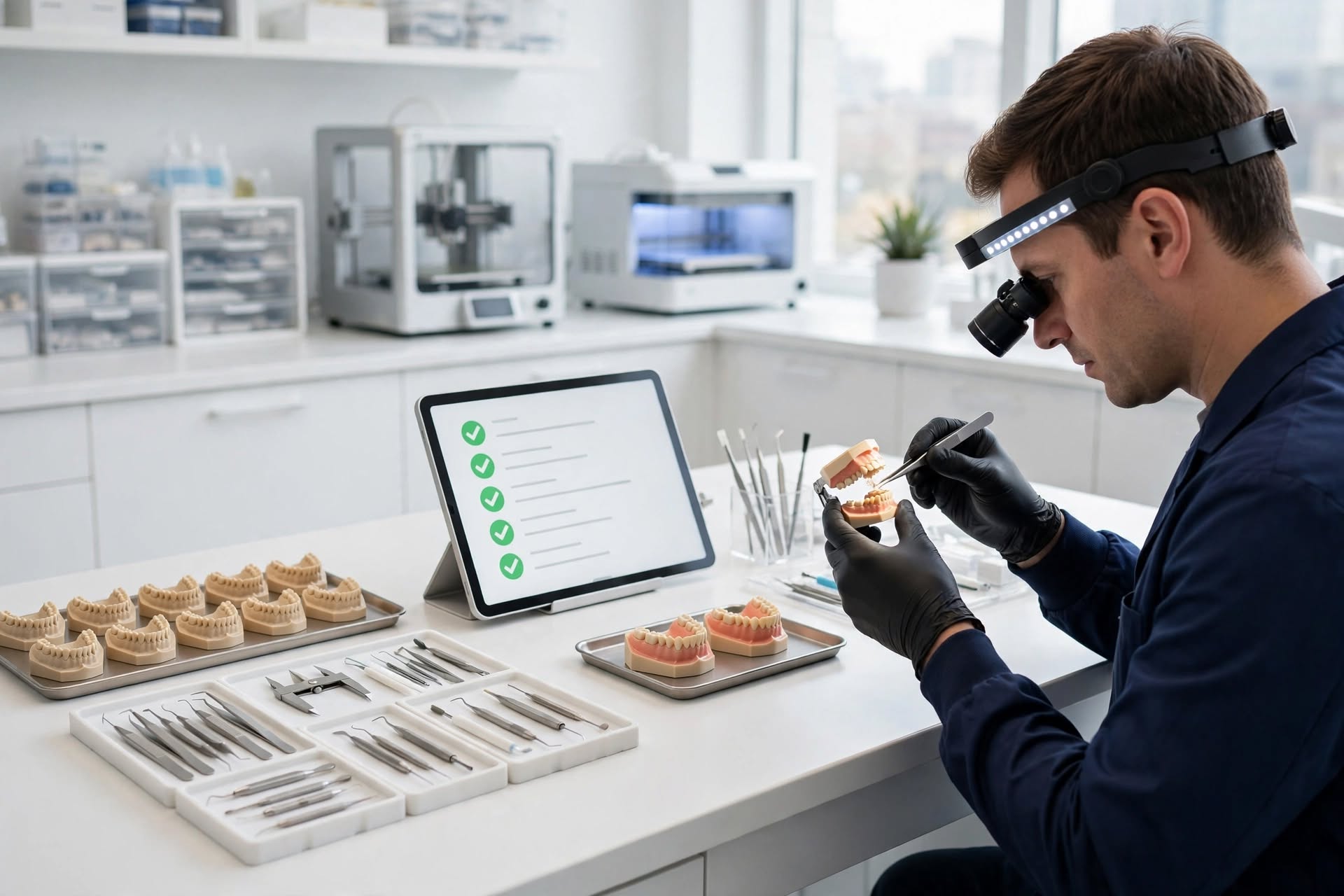
- Quality control
- Final cleaning and packaging
Using consistent checkpoints makes it easier to identify errors before the restoration reaches the dental practice.
Use Digital Workflows Effectively
Digital dentistry can improve consistency throughout many laboratory processes.
Intraoral scans, CAD software, digital articulation, and CAD/CAM manufacturing can provide technicians with detailed information and greater control over restoration design.
However, digital technology does not automatically eliminate errors.
Incorrect scan data, incomplete margins, inaccurate bite scans, or inappropriate CAD parameters can still produce an unsatisfactory restoration.
Technology should therefore be combined with skilled technician oversight and systematic quality control.
Verify Margins Before Manufacturing
Accurate margin identification is essential for crowns, bridges, veneers, and other indirect restorations.
Before manufacturing begins, technicians should verify that the preparation margins are clearly visible and correctly defined in the digital model.
If the margin is unclear or incomplete, contacting the dental practice before production may prevent an otherwise unnecessary remake.
Pay Attention to Occlusion
Occlusal discrepancies are another potential source of restoration adjustments and remakes.
Accurate bite records and appropriate articulation allow technicians to evaluate the relationship between the restoration and opposing dentition.
This is particularly important for multiple-unit restorations, implant-supported prostheses, and full-mouth rehabilitation cases.
Improve Shade Communication
Aesthetic mismatches can result in remakes even when the restoration is technically accurate.
Shade selection should therefore be supported by appropriate clinical information. Standardized photographs, shade tabs, and clear instructions can help technicians understand the desired result.
For highly aesthetic anterior cases, photographs showing the patient’s surrounding teeth can provide valuable information about translucency, characterization, surface texture, and overall color relationships.
Establish Quality Control Checkpoints
Quality control should not be limited to the final stage of production.
Multiple checkpoints can be introduced throughout the workflow.
For example:
Before design:
Verify the prescription, scan quality, margins, bite information, and available restorative space.
During design:
Check anatomy, contacts, occlusion, emergence profile, and material requirements.
After manufacturing:
Evaluate fit, margins, contacts, surface quality, shade, and overall morphology.
Before delivery:
Complete a final inspection to confirm that the restoration meets the laboratory prescription.
This systematic approach can help identify problems before they become costly remakes.
Track and Analyze Remake Data
One of the most effective ways to improve laboratory performance is to monitor remake patterns.
Instead of simply recording that a case was remade, laboratories can document the reason.
Useful categories may include:
- Impression or scan issue
- Bite discrepancy
- Shade mismatch
- Poor preparation
- Design error
- Manufacturing defect
- Material issue
- Communication error
- Clinical change
Analyzing this information over time can reveal recurring problems and help laboratory managers determine where workflow improvements are needed.
How to Reduce Dental Laboratory Remakes
To reduce dental laboratory remakes, laboratories should focus on prevention rather than relying only on final inspection.
A practical approach includes:
- Creating standardized case acceptance protocols
- Reviewing prescriptions before production
- Verifying digital scans and preparation margins
- Using reliable bite records
- Requesting photographs for aesthetic cases
- Maintaining clear dentist–technician communication
- Applying quality-control checkpoints
- Tracking remake reasons
- Providing technician training
- Reviewing recurring workflow problems regularly
These measures can improve consistency while reducing wasted materials, production time, and unnecessary communication.
The Role of Technician Expertise
Technology can improve precision, but experienced dental technicians remain essential to the laboratory workflow.
Technicians must recognize when digital information does not correspond with the clinical situation and know when additional information is required.
Professional judgment is particularly important in complex restorative cases where aesthetics, function, material properties, and biological considerations must be evaluated together.
Why Remake Prevention Matters
Reducing remakes benefits more than laboratory productivity.
Fewer remakes can help:
- Lower material and production costs
- Improve laboratory efficiency
- Reduce treatment delays
- Minimize chairside adjustments
- Improve dentist–laboratory relationships
- Support a better patient experience
- Increase overall workflow predictability
For this reason, remake prevention should be considered part of a laboratory’s overall quality-management strategy.
Conclusion
Remakes are an important challenge for dental laboratories, but many common causes can be addressed through better processes and communication.
Accurate clinical records, standardized workflows, digital technology, technician expertise, effective quality control, and systematic analysis of remake data can all contribute to more predictable restoration production.
The goal is not simply to fix errors faster but to identify where errors originate and prevent them from occurring in the first place.
By focusing on these areas, dental laboratories can reduce dental laboratory remakes, improve operational efficiency, and provide dentists with more consistent restorative outcomes.
Frequently Asked Questions
What is the most common cause of dental laboratory remakes?
There is no single cause for every laboratory. Remakes can result from inaccurate clinical records, communication problems, preparation issues, design errors, manufacturing problems, or changes in the clinical case.
Can digital dentistry reduce laboratory remakes?
Digital workflows can improve consistency and provide better control over scanning, design, and manufacturing. However, accurate data and experienced technicians remain essential.
How can dentists help prevent laboratory remakes?
Dentists can provide accurate impressions or scans, reliable bite records, appropriate photographs, complete prescriptions, clear shade information, and detailed clinical instructions.
Why is quality control important in dental laboratories?
Quality control allows potential problems to be identified before the restoration reaches the patient, helping prevent avoidable adjustments and remakes.
How should laboratories track remake rates?
Laboratories can record each remake and categorize its cause. Reviewing these patterns regularly can help identify recurring problems and guide workflow improvements.