New Jersey, USA


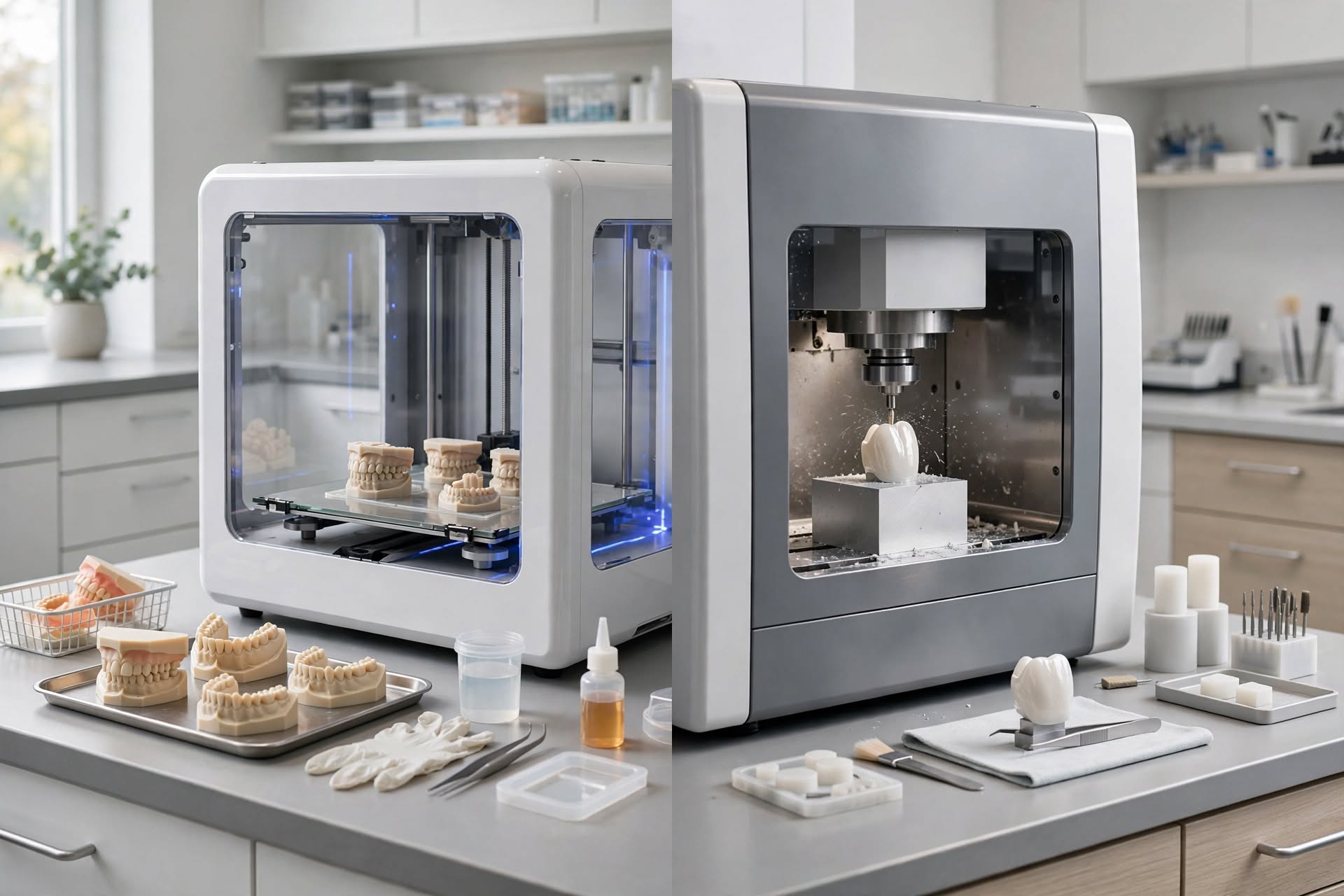
Modern dental laboratories have more digital manufacturing options than ever before. Two of the most widely used technologies are 3D printing and CAD/CAM milling. Both can produce highly customized dental restorations and laboratory components, but they use fundamentally different manufacturing approaches.
Understanding the differences between these technologies helps dental laboratories choose the right workflow for each case, balancing accuracy, material requirements, production speed, finishing needs, and cost.
What Is 3D Printing in Dentistry?
Dental 3D printing is an additive manufacturing process. Instead of removing material from a solid block, the printer builds an object layer by layer based on a digital design.
Depending on the printer and material, 3D printing can be used to produce:
- Surgical guides
- Dental models
- Custom trays
- Temporary restorations
- Dentures and denture components
- Orthodontic appliances
- Prototypes and diagnostic models
The technology is particularly useful when laboratories need to manufacture complex shapes while minimizing material waste.
What Is CAD/CAM Milling?
CAD/CAM milling is a subtractive manufacturing process. A restoration is digitally designed using CAD software and then milled from a prefabricated block or disc.
Dental laboratories commonly use milling for:
- Zirconia crowns and bridges
- PMMA temporary restorations
- Implant-supported restorations
- Inlays and onlays
- Full-arch frameworks
- Certain ceramic and composite restorations
Milling is especially valuable when a restoration requires consistent material properties, precise margins, and a highly controlled manufacturing process.
3D Printing vs CAD/CAM Milling: Key Differences
Although both technologies begin with digital data, their manufacturing methods are very different.
| Factor | 3D Printing | CAD/CAM Milling |
|---|---|---|
| Manufacturing method | Additive | Subtractive |
| Material use | Generally efficient | More material waste from milling |
| Complex geometries | Excellent | More dependent on milling limitations |
| Material options | Growing rapidly | Broad range of established blocks/discs |
| Surface finish | Usually requires post-processing | Often requires less finishing |
| Production workflow | Printing + post-processing | Milling + finishing/sintering when applicable |
| Scalability | Excellent for multiple smaller objects | Excellent for restorations and larger structures |
| Common applications | Models, guides, appliances, temporaries | Crowns, bridges, frameworks, definitive restorations |
The best technology is therefore not determined by speed or cost alone. The clinical indication and required material properties should always be considered first.
Accuracy and Precision
Accuracy is one of the most important considerations in dental laboratory manufacturing.
Modern 3D printers can achieve highly detailed results, particularly for models, guides, and appliances. However, accuracy can be influenced by printer calibration, layer thickness, resin characteristics, orientation, support placement, and post-processing.
Milling systems can provide highly consistent results when the digital workflow, milling machine, tooling, and material are properly controlled. For restorations with demanding margins and contacts, the complete CAD/CAM workflow plays an important role in achieving predictable results.
Rather than asking which technology is always more accurate, laboratories should evaluate accuracy according to the specific application.
Production Speed and Workflow Efficiency
3D printing can be highly efficient when producing multiple models, guides, or appliances simultaneously. A single print cycle may manufacture several components at once.
Milling can be efficient for individual or small-batch restorations, particularly when the laboratory already has an established digital workflow.
However, production time does not end when the machine finishes. 3D printing may require washing, support removal, curing, and finishing. Milling may require additional processes such as sintering, polishing, staining, or glazing depending on the material.
Therefore, laboratories should evaluate total workflow time, rather than only machine operating time.
Material Considerations
Material selection is a major difference between additive and subtractive manufacturing.
Milling systems work with established dental blocks and discs, including materials such as zirconia, PMMA, ceramics, and certain composite materials. These materials can offer predictable mechanical and aesthetic characteristics when used according to manufacturer specifications.
3D printing uses specialized printable materials, including resins developed for models, surgical guides, temporary applications, dentures, orthodontic appliances, and other indications.
As printable dental materials continue to develop, the range of laboratory applications is also expanding.
Material Waste
One of the clearest differences is material consumption.
Milling begins with a larger block or disc and removes material until the final restoration is produced. Some of the unused material becomes milling waste.
3D printing builds only the geometry required for the design, although supports and failed prints still contribute to material consumption.
For laboratories focused on improving material efficiency and reducing manufacturing waste, additive manufacturing can provide an important advantage for suitable applications.
Surface Finish and Post-Processing
Surface quality is another important consideration.
Milled restorations can often achieve a smooth and consistent surface directly from the manufacturing process, although additional polishing, staining, glazing, or finishing may still be required.
3D-printed components typically require several post-processing steps. These may include cleaning, support removal, curing, polishing, or other finishing procedures depending on the material and indication.
Consequently, the initial manufacturing time should not be considered separately from the finishing workflow.
Which Technology Is Better for Dental Laboratories?
There is no universal winner in the 3D printing vs CAD/CAM milling debate because the ideal solution depends on the laboratory’s workflow and the type of work being produced.
3D printing may be preferable when:
- Multiple components need to be produced simultaneously
- Complex geometries are required
- Models or surgical guides are being manufactured
- Material efficiency is important
- Rapid prototyping is needed
- The laboratory produces high volumes of similar components
CAD/CAM milling may be preferable when:
- Definitive restorations are being manufactured
- Established block or disc materials are required
- Highly predictable material properties are important
- Precise crowns and bridges are needed
- The laboratory already has an efficient milling workflow
- A specific material is not available in printable form
Why Many Laboratories Use Both Technologies
The choice does not have to be one technology or the other.
A modern dental laboratory can combine additive and subtractive manufacturing to create a more efficient digital workflow. For example, a laboratory may use 3D printing for models and surgical guides while using milling for zirconia crowns and implant-supported restorations.
This hybrid approach allows technicians to select the manufacturing method according to the requirements of each case rather than forcing every application into a single production system.
How to Choose the Right Manufacturing Technology
Before selecting a manufacturing method, dental laboratories should consider several factors:
1. Clinical indication
Determine exactly what is being manufactured and what performance requirements it must meet.
2. Material requirements
Choose a material that is appropriate for the intended application and compatible with the manufacturing technology.
3. Required accuracy
Consider margins, fit, contacts, occlusion, and the dimensional requirements of the restoration.
4. Production volume
High-volume workflows may benefit from batch 3D printing, while certain restoration workflows may be more efficient with milling.
5. Post-processing requirements
Include cleaning, curing, sintering, polishing, staining, glazing, and other finishing procedures when calculating production time.
6. Total cost
Equipment, materials, maintenance, labor, software, consumables, and failed production should all be included when evaluating costs.
The Future of Digital Dental Manufacturing
Both additive and subtractive technologies continue to evolve. Improvements in printer resolution, printable materials, automation, milling systems, software integration, and quality-control processes are making digital manufacturing increasingly versatile.
The future of dental laboratory production is unlikely to depend on a single manufacturing method. Instead, successful laboratories will increasingly combine different technologies according to the requirements of each case.
Conclusion
The choice between 3D printing and CAD/CAM milling should be based on the specific restoration, material, accuracy requirements, production volume, finishing process, and overall laboratory workflow.
For complex, scalable, and material-efficient production, 3D printing can be highly valuable. For definitive restorations requiring established dental materials and predictable manufacturing characteristics, milling remains an important technology.
Ultimately, the most efficient dental laboratory is not necessarily the one that chooses one technology over another, but the one that understands when to use each technology and integrates them effectively into its digital workflow.