New Jersey, USA


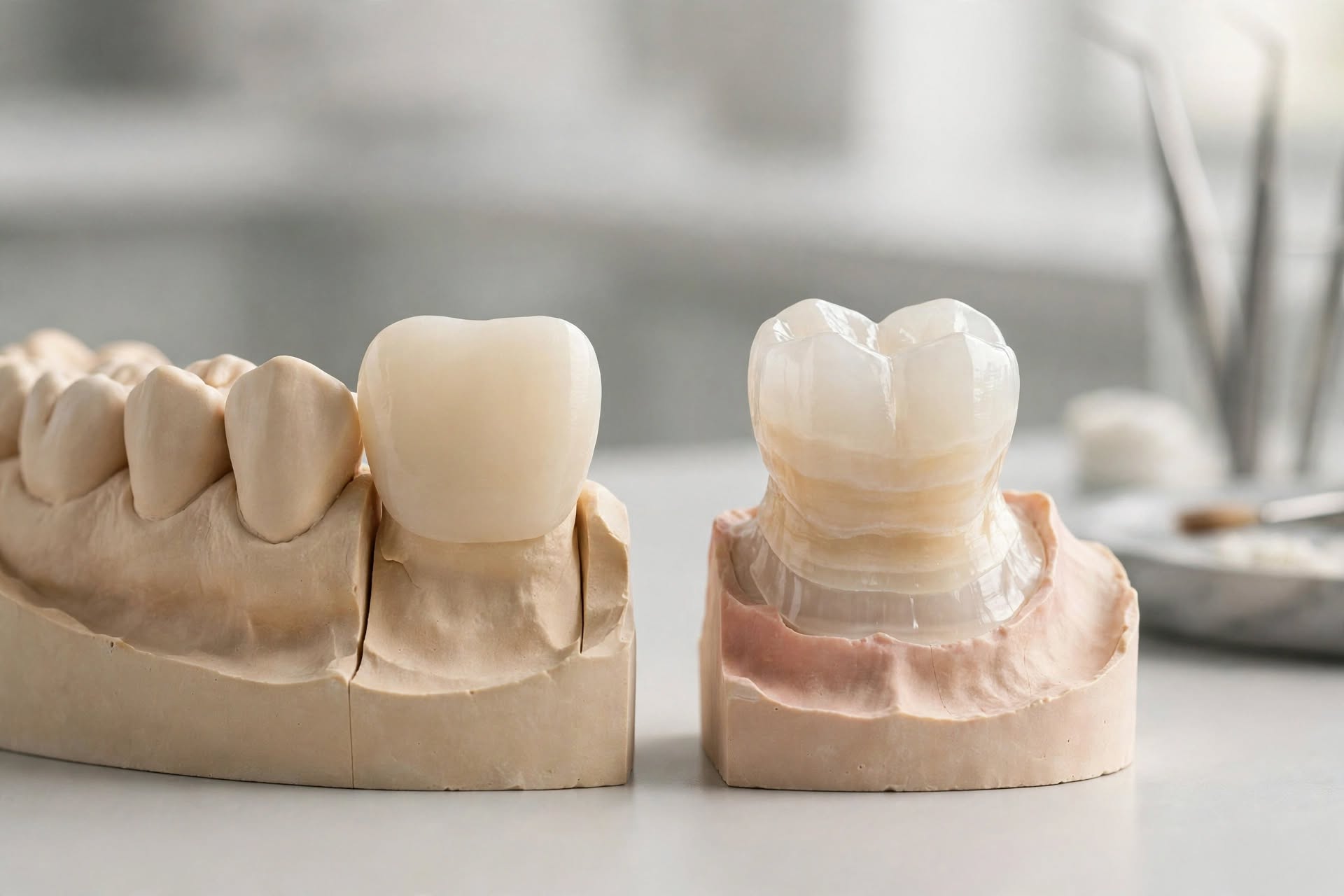
Zirconia has become one of the most widely used materials in modern dental laboratories because of its strength, versatility, and increasingly natural optical properties. However, choosing the right restoration design is just as important as choosing the material itself.
Two common approaches are monolithic zirconia and layered zirconia. While both can provide functional and aesthetic results, they differ significantly in fabrication, appearance, strength, workflow, and clinical indications.
Understanding these differences allows dental technicians and clinicians to select the most appropriate approach for each case.
What Is Monolithic Zirconia?
Monolithic zirconia restorations are manufactured entirely from a single zirconia structure. Instead of applying a separate ceramic veneer over a zirconia framework, the restoration is milled from a zirconia disc and then finished through processes such as sintering, staining, and polishing or glazing.
Modern multilayer zirconia materials can incorporate different levels of translucency and color within the same disc. This allows technicians to achieve more natural-looking restorations without adding a separate veneering ceramic.
Advantages of Monolithic Zirconia
- High resistance to chipping because there is no veneering layer
- Efficient digital manufacturing workflow
- Reduced laboratory processing time
- Good functional performance
- Suitable for many posterior restorations
- Consistent material structure
- Available in different translucency levels and multilayer configurations
Monolithic zirconia can be particularly practical when durability and workflow efficiency are major priorities.
What Is Layered Zirconia?
Layered zirconia consists of a zirconia framework covered with veneering ceramic. The zirconia provides the structural foundation, while the ceramic layer is applied to create additional depth, translucency, characterization, and aesthetic detail.
This technique gives dental technicians greater freedom to reproduce natural tooth anatomy and optical characteristics.
Advantages of Layered Zirconia
- Highly customizable aesthetics
- Greater control over translucency and characterization
- Ability to create detailed surface anatomy
- Suitable for demanding anterior aesthetic cases
- Can reproduce complex shade transitions
- Allows technicians to customize individual areas of the restoration
For highly aesthetic cases, layered zirconia can provide a level of customization that may be difficult to achieve with a purely monolithic design.
Monolithic vs Layered Zirconia: Key Differences
The choice between the two approaches depends on the priorities of each case.
| Feature | Monolithic Zirconia | Layered Zirconia |
|---|---|---|
| Structure | Single zirconia material | Zirconia framework + ceramic veneer |
| Chipping risk | Generally lower | Veneering ceramic can chip |
| Aesthetic customization | Good to excellent depending on material | Excellent |
| Production workflow | More streamlined | More laboratory stages |
| Surface characterization | Staining, polishing, glazing | Extensive ceramic layering possible |
| Strength considerations | Strong monolithic structure | Depends on framework and veneering ceramic |
| Posterior applications | Often highly suitable | Suitable when additional aesthetics are required |
| Anterior aesthetics | Suitable with advanced materials | Particularly useful for demanding cases |
Strength and Functional Considerations
One of the primary reasons laboratories use monolithic zirconia is its continuous structure. Since there is no separate veneering ceramic, there is no interface between a zirconia framework and a veneering layer that can experience chipping.
However, strength should never be considered in isolation. Zirconia type, thickness, connector dimensions, preparation design, occlusal forces, sintering protocol, and restoration geometry can all influence the final performance.
Layered zirconia can also provide excellent functional results when the framework is appropriately designed and the veneering ceramic is correctly applied.
Aesthetic Considerations
Aesthetics are where the difference between the two approaches becomes particularly important.
Modern zirconia materials offer improved translucency and multilayer color effects, allowing monolithic restorations to achieve increasingly natural results. Skilled staining and glazing can further enhance their appearance.
Layered zirconia, however, gives technicians greater control over optical depth. Different ceramic powders and layering techniques can be used to reproduce subtle characteristics such as enamel effects, incisal translucency, internal characterization, and natural surface morphology.
For highly demanding anterior restorations, the additional customization possible with ceramic layering may be valuable.
Which Approach Is More Efficient?
From a laboratory workflow perspective, monolithic zirconia is generally more streamlined. The restoration can be digitally designed, milled, sintered, and subsequently characterized and polished or glazed.
Layered zirconia requires additional technician time because the ceramic must be applied, fired, adjusted, and finished.
This does not mean that one approach is universally better. The additional laboratory work involved in layering can be justified when the case requires a higher level of aesthetic customization.
Choosing the Right Approach for Different Cases
Monolithic zirconia may be a good option for:
- Posterior crowns
- Implant-supported restorations where appropriate
- Patients with high functional demands
- Cases where chipping resistance is a major consideration
- Efficient digital workflows
- Restorations where moderate to high aesthetics can be achieved without layering
Layered zirconia may be preferred for:
- Highly aesthetic anterior restorations
- Complex shade-matching cases
- Restorations requiring detailed characterization
- Cases where maximum aesthetic customization is important
- Situations where natural optical depth is a primary objective
The final decision should always consider the clinical indication, available material, preparation design, occlusion, aesthetic expectations, and laboratory capabilities.
The Role of Digital Dentistry
Digital workflows have made both zirconia approaches more predictable and efficient.
CAD software allows technicians to control restoration anatomy, thickness, contacts, occlusion, and connector dimensions before manufacturing begins. Milling technology then translates the digital design into a physical restoration.
For monolithic restorations, this digital workflow can significantly simplify production. For layered restorations, digital manufacturing can provide a highly accurate zirconia framework that serves as the foundation for subsequent ceramic characterization.
Quality Control in Zirconia Restorations
Regardless of the chosen approach, quality control remains essential.
Dental laboratories should carefully evaluate:
- Digital scan quality
- Preparation margins
- Restoration thickness
- Occlusal contacts
- Interproximal contacts
- Connector dimensions
- Milling accuracy
- Sintering parameters
- Shade and translucency
- Surface texture
- Final fit
A technically excellent material can still produce an unsatisfactory restoration if the digital design, manufacturing, or finishing stages are not properly controlled.
Is One Approach Better Than the Other?
There is no universal answer to the monolithic vs layered zirconia question.
Monolithic zirconia offers a streamlined workflow, strong continuous structure, and increasingly sophisticated aesthetic possibilities. Layered zirconia provides greater artistic freedom and can be especially valuable when complex anterior aesthetics are the primary objective.
The best approach is therefore the one that matches the requirements of the individual case rather than simply choosing the newest or strongest option.
Conclusion
Both monolithic and layered zirconia have an important role in modern dental laboratory workflows. The decision should be based on a combination of functional requirements, aesthetic expectations, material properties, production efficiency, and technician expertise.
For laboratories prioritizing efficiency and structural consistency, monolithic zirconia can be an excellent solution. When maximum customization and detailed aesthetics are required, layered zirconia may offer significant advantages.
Understanding the strengths and limitations of each technique enables dental laboratories and clinicians to create more predictable, functional, and natural-looking restorations.