New Jersey, USA


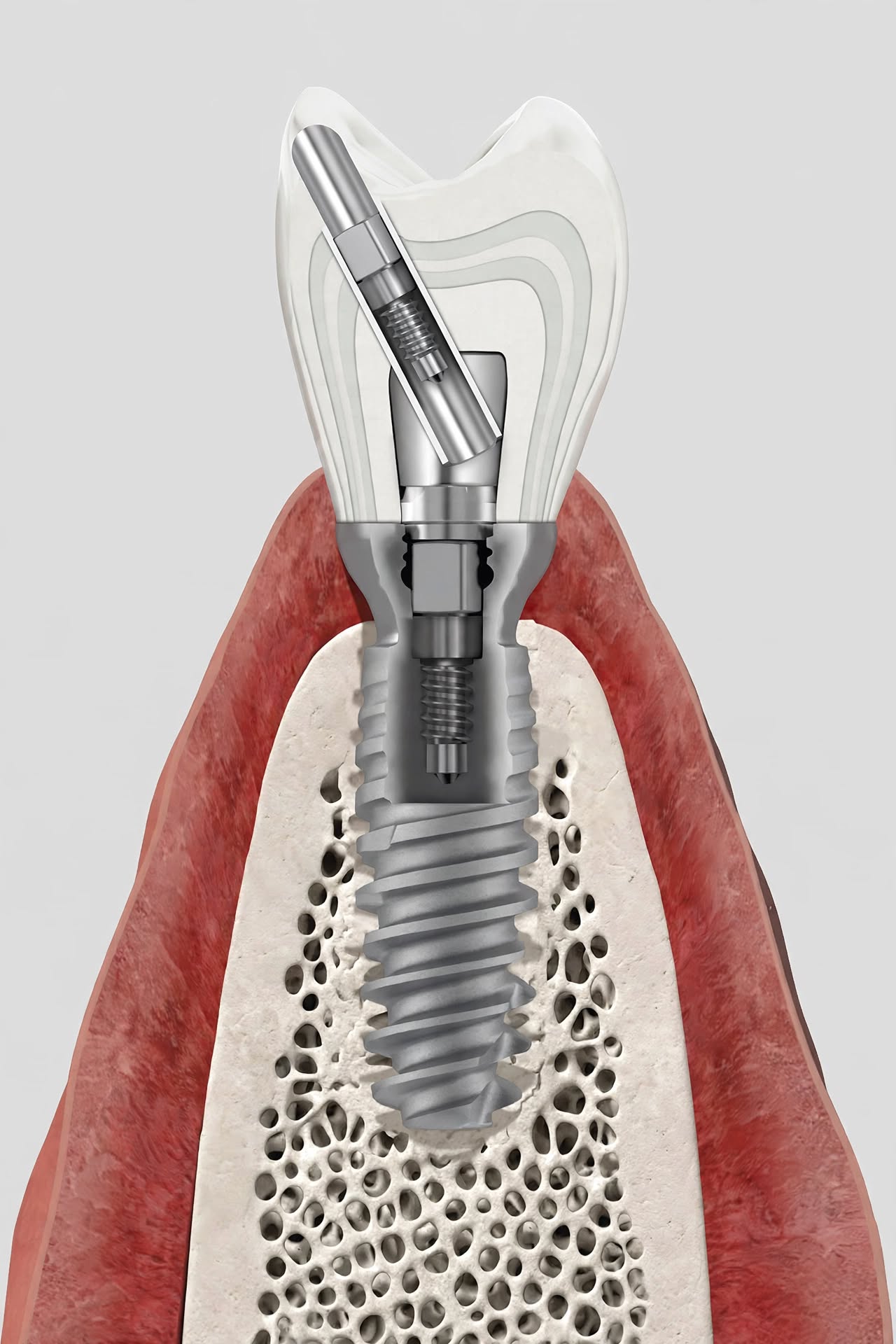
Implant-supported restorations require precise planning at both the clinical and laboratory stages. One detail that can significantly influence the function, aesthetics, and long-term maintenance of a restoration is the position and design of the screw access channel.
Proper screw access channel design helps ensure that the prosthetic screw can be accessed when necessary while maintaining adequate restorative material around the channel.
What Is a Screw Access Channel?
A screw access channel is the opening through an implant-supported restoration that allows the clinician to reach the prosthetic screw.
In a screw-retained restoration, this channel is necessary for seating, tightening, maintenance, and potential future removal of the prosthesis.
Its position should therefore be considered during the digital design stage rather than treated as a simple opening created after fabrication.
Why Does Screw Access Position Matter?
The location of the screw access channel can affect several aspects of an implant restoration.
1. It Can Influence Aesthetics
On anterior restorations, an access channel positioned through the facial or visible surface may compromise the appearance of the restoration.
When implant angulation allows it, the channel can ideally be positioned in a less visible area, such as the palatal or lingual surface.
Digital planning allows technicians to evaluate implant positioning and restorative contours before manufacturing.
2. It Helps Maintain Material Strength
The access channel removes material from the restoration. If it is positioned too close to an incisal edge, cusp, or thin area, the remaining material may become insufficient.
During CAD design, technicians should evaluate the thickness surrounding the channel and ensure that the restoration maintains adequate structural support.
This is particularly important for ceramic and zirconia restorations.
3. Implant Angulation Can Affect the Channel
The final position of the screw access channel is strongly influenced by implant angulation.
If an implant is significantly angled, the screw channel may emerge in an unexpected area of the restoration. This can create challenges for both aesthetics and restorative design.
Angled screw-channel solutions and appropriate prosthetic components may help address some of these situations, depending on the implant system and clinical requirements.
Screw Access Channels and Occlusion
Occlusal contacts should be carefully considered when designing the access channel.
If the opening is positioned directly within an important functional contact area, it may affect the available restorative material and the final occlusal design.
The technician should therefore evaluate the channel together with the patient’s occlusion rather than designing these elements independently.
Digital articulation can help identify potential conflicts before manufacturing.
The Role of CAD/CAM Technology
Modern CAD software gives dental technicians greater control over implant restoration design.
During the digital workflow, the technician can evaluate:
- Implant position
- Screw channel angulation
- Restoration thickness
- Occlusal contacts
- Emergence profile
- Connector dimensions
- Overall anatomy
This makes screw access channel design an important part of the digital planning process.
A well-planned digital workflow can help identify potential problems before the restoration is manufactured, reducing unnecessary adjustments and remakes.
Material Considerations
Different restorative materials respond differently to changes in thickness and design.
Zirconia, lithium disilicate, metal frameworks, and other restorative materials have different mechanical and aesthetic characteristics. The technician should consider the material being used when determining the dimensions and position of the access channel.
For example, maintaining sufficient ceramic thickness around the channel is important when working with aesthetic ceramic restorations.
Finishing the Screw Access Channel
After fabrication, the access channel must be finished carefully.
Sharp edges, irregular surfaces, or inadequate finishing may interfere with the final restoration or create difficulties during clinical access.
The channel should be clean, smooth, and appropriately shaped for the corresponding screw and clinical instrumentation.
Screw Access and Long-Term Maintenance
One advantage of screw-retained implant restorations is that they can generally be removed when maintenance or repair is required.
For this reason, the access channel needs to remain clinically accessible.
A poorly positioned or inadequately designed channel can make future access more difficult and complicate maintenance procedures.
This is another reason screw access channel design should be planned carefully from the beginning of the laboratory workflow.
Communication Between Dentist and Laboratory
Successful implant restoration design depends on accurate communication.
The dentist and technician should consider implant system, implant position, restoration type, screw requirements, occlusal conditions, material selection, and aesthetic expectations.
When these factors are communicated clearly, the laboratory can create a restoration that better meets the clinical requirements.
Conclusion
The screw access channel is a small component of an implant restoration, but its position can influence aesthetics, material strength, occlusion, clinical accessibility, and long-term maintenance.
Careful screw access channel design allows dental technicians to integrate the channel into the restoration rather than treating it as an isolated feature.
With accurate implant records, digital CAD/CAM planning, appropriate material selection, and effective dentist–laboratory communication, screw-retained restorations can be designed with greater precision and predictability.