New Jersey, USA


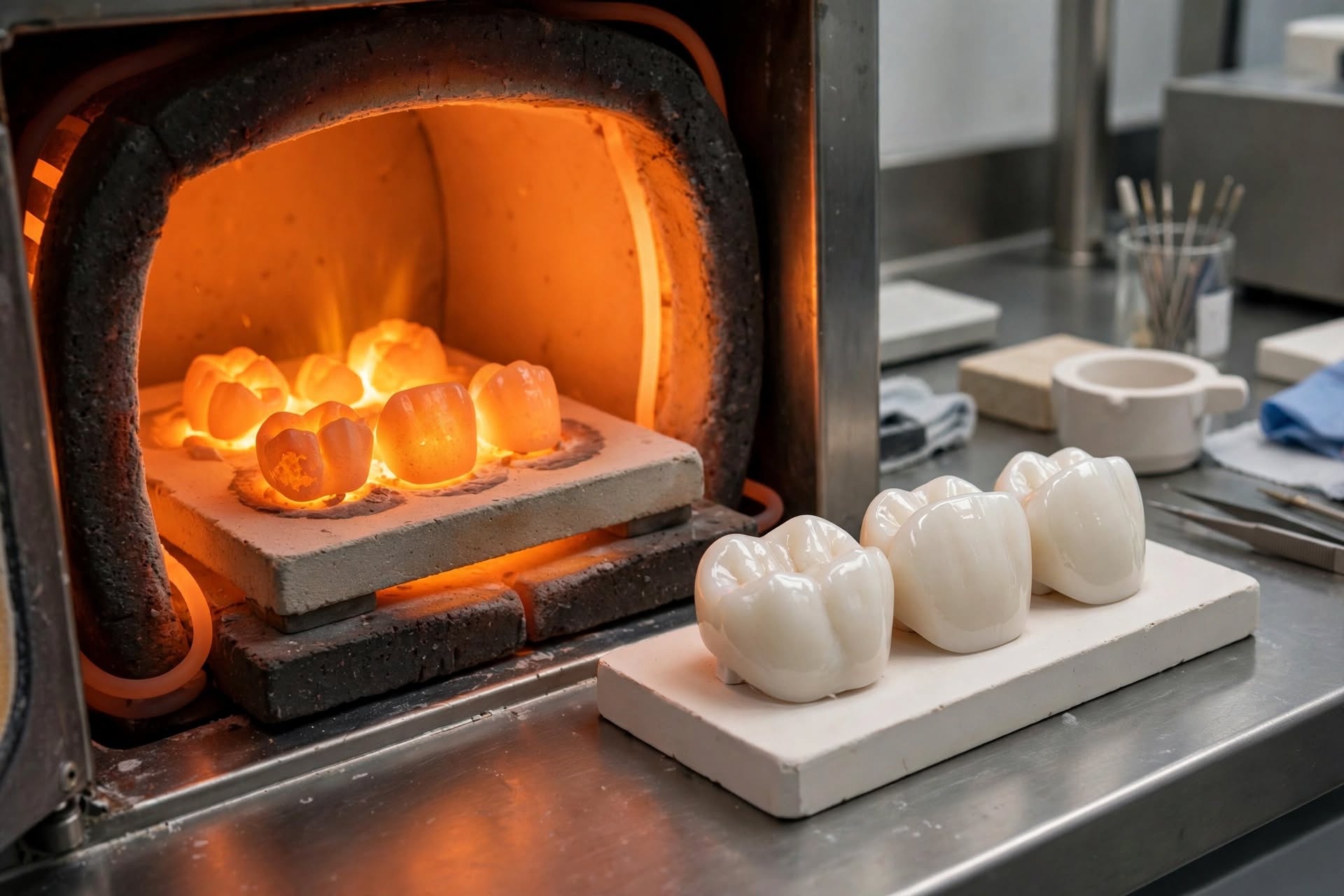
Zirconia is widely used in modern dental laboratories because of its strength, durability, and natural-looking aesthetics. However, achieving a precise zirconia restoration requires more than accurate digital design and milling. One of the most critical stages in the manufacturing process is sintering, which directly influences the final dimensions, fit, and appearance of the restoration.
Understanding how sintering affects zirconia restorations helps dental technicians improve consistency, reduce remakes, and deliver more predictable results.
What Is Sintering in Dental Zirconia?
Sintering is a heat-treatment process that transforms milled zirconia into a dense, strong ceramic restoration. During this process, the zirconia particles bond together as the material shrinks and develops its final mechanical properties.
Before sintering, zirconia restorations are typically milled in a partially sintered state. The restoration is designed at an enlarged size to compensate for the shrinkage that occurs during the final sintering cycle.
The accuracy of this compensation is essential. Even small variations in shrinkage can affect marginal fit, contact points, occlusion, and the overall fit of the restoration.
How Does Sintering Affect Accuracy?
1. Shrinkage and Dimensional Stability
Shrinkage is one of the most important factors affecting zirconia accuracy. During sintering, the material contracts as it becomes denser. CAD/CAM software uses the manufacturer’s specified shrinkage factor to calculate the enlarged milling dimensions.
If the shrinkage factor is inaccurate or the material is inconsistent, the final restoration may not match the original digital design.
For dental laboratories, correct calibration and consistent processing are essential to maintaining dimensional accuracy.
2. Sintering Temperature and Time
Temperature and duration influence the density, grain structure, translucency, and mechanical properties of zirconia. An unsuitable sintering cycle may affect the final quality of the restoration.
Depending on the zirconia material, excessively high temperatures or prolonged sintering may alter grain growth and optical properties. Insufficient sintering can compromise density and strength.
Dental technicians should always follow the material manufacturer’s recommended sintering protocol rather than applying one cycle to every zirconia product.
3. Restoration Size and Geometry
The shape and thickness of a restoration can influence how it behaves during sintering. Long-span bridges, thin structures, and restorations with uneven thickness may be more susceptible to distortion under certain processing conditions.
Proper support, suitable positioning in the sintering furnace, and consistent loading procedures can help reduce the risk of deformation.
4. Marginal Fit and Occlusion
The final accuracy of zirconia restorations is particularly important at the margins and occlusal surfaces. Dimensional changes during sintering can affect how a crown fits the prepared tooth and how it contacts opposing teeth.
If the restoration requires excessive adjustment after sintering, it may increase laboratory time and potentially affect the quality of the final result.
Careful evaluation after sintering helps technicians identify discrepancies before the restoration is delivered to the dentist.
Best Practices for Improving Sintering Accuracy
Dental laboratories can improve the predictability of zirconia restorations by following several essential practices:
-
Verify shrinkage factors: Use the correct material-specific scaling information in the CAD/CAM system.
-
Maintain furnace calibration: Regularly check the accuracy and consistency of the sintering furnace.
-
Follow manufacturer instructions: Apply the recommended heating rates, holding times, and cooling procedures.
-
Position restorations correctly: Follow appropriate loading and support guidelines, particularly for long-span bridges.
-
Avoid inconsistent workflows: Keep processing parameters stable between production batches.
-
Inspect the final restoration: Evaluate marginal adaptation, proximal contacts, occlusion, and overall fit after sintering.
These practices help reduce dimensional variations and support more reliable manufacturing outcomes.
The Role of Digital Dentistry in Zirconia Accuracy
Digital workflows have improved the control dental laboratories have over restoration design and manufacturing. CAD/CAM systems, accurate milling machines, and well-maintained sintering furnaces work together to produce predictable results.
However, digital precision alone cannot guarantee a perfect restoration. The final outcome depends on the entire workflow, including scanning, design, milling, material handling, and sintering.
By combining accurate digital planning with controlled sintering procedures, dental technicians can improve production consistency and reduce the need for remakes.
Conclusion
Sintering is a crucial stage in zirconia manufacturing because it determines the final dimensions and contributes to the material’s mechanical and aesthetic properties. Proper shrinkage compensation, accurate temperature control, and consistent furnace procedures are essential for achieving reliable results.
For dental laboratories, understanding how sintering affects the accuracy of zirconia restorations supports better marginal fit, more predictable occlusion, and improved production efficiency. A controlled and standardized workflow is key to producing high-quality zirconia restorations.