New Jersey, USA


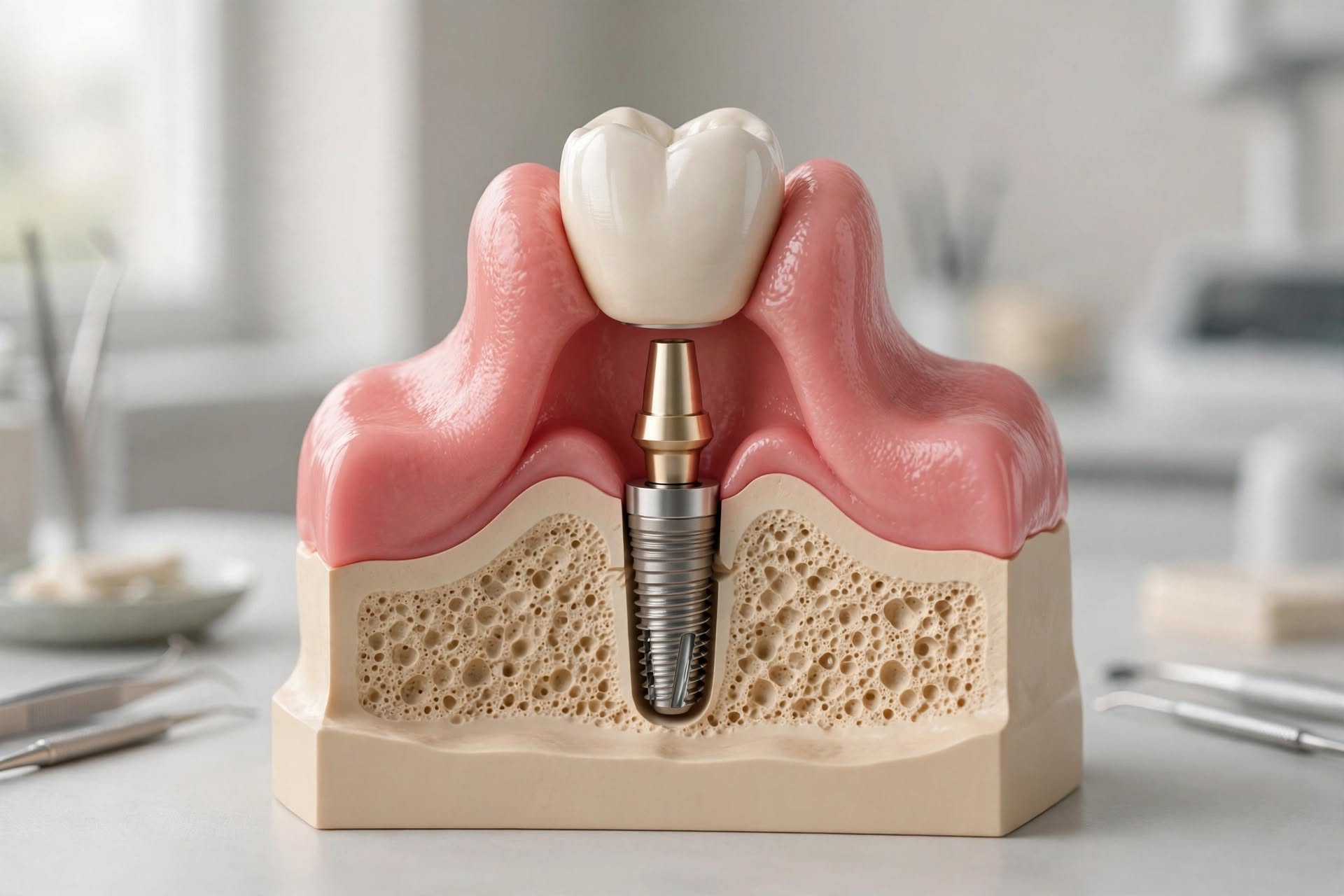
Successful implant restorations depend on more than implant position and restorative materials. The surrounding gingival tissue plays an important role in determining the appearance, emergence profile, contours, and long-term performance of an implant-supported restoration.
Understanding soft tissue considerations is therefore essential for dentists and dental technicians when planning implant crowns, bridges, and full-arch restorations.
Why Is Soft Tissue Important in Implant Restoration?
Natural teeth are surrounded by periodontal tissues that help create a smooth transition between the tooth and gingiva. Dental implants have a different anatomical relationship with the surrounding tissues.
Because implants do not have a periodontal ligament, the peri-implant soft tissue architecture develops differently from natural dentition. This makes restoration design particularly important in achieving both functional stability and a natural appearance.
For dental laboratories, understanding the available soft tissue space can help technicians design restorations that properly support the surrounding gingiva without creating excessive pressure or unnatural contours.
How Soft Tissue Influences the Emergence Profile
The emergence profile describes how a restoration transitions from the implant or abutment area into the visible crown.
An appropriately designed emergence profile can help create a natural-looking transition between the restoration and surrounding tissue.
An overly bulky emergence profile may:
- Put unnecessary pressure on the soft tissue
- Make oral hygiene more difficult
- Create an unnatural appearance
- Affect the position and contour of the gingiva
On the other hand, an emergence profile that is too narrow or inadequately supported may compromise the desired aesthetic result.
The ideal contour depends on the implant position, tissue thickness, restoration type, and individual anatomy.
Soft Tissue Thickness and Restoration Contour
Soft tissue thickness varies between patients and different areas of the mouth. The anterior region is particularly demanding because even small changes in gingival contour can affect the appearance of the smile.
When designing an implant restoration, technicians should consider:
- Tissue thickness
- Gingival architecture
- Implant position
- Cervical contour
- Emergence profile
- Interproximal tissue
- Available restorative space
These factors should be evaluated together rather than independently.
The Role of Digital Dentistry
Digital workflows have made communication between the dental clinic and laboratory more precise.
Intraoral scans can capture the visible soft tissue architecture, while photographs and CBCT imaging can provide additional information about implant position and surrounding anatomy.
Combining these digital records allows the dental team to better understand the relationship between the implant, restoration, and soft tissue.
For laboratories, accurate digital information can support more predictable CAD/CAM design and help technicians develop restoration contours according to the clinical situation.
Anterior Implant Restorations and Aesthetic Demands
Soft tissue management becomes especially important in the anterior region.
The position of the gingival margin, papillae, tissue thickness, and symmetry between adjacent teeth can significantly influence the final aesthetic result.
A restoration may have excellent shape and shade but still appear unnatural if its cervical contours do not harmonize with the surrounding gingiva.
For this reason, implant restoration design should consider both the crown itself and the three-dimensional environment surrounding it.
How Soft Tissue Affects Full-Arch Restorations
Soft tissue considerations are also important when designing full-arch implant-supported prostheses.
In full-arch cases, the restoration must provide appropriate support for the lips and facial tissues while maintaining sufficient space for hygiene.
The transition between the prosthesis and the soft tissue should be carefully planned. Excessive contouring can make cleaning difficult, while insufficient support may compromise facial aesthetics.
Digital planning can help the laboratory evaluate tooth position, prosthetic contours, and available restorative space before manufacturing the final restoration.
Communication Between Dentist and Dental Technician
Successful implant restoration design requires effective communication between the clinical and laboratory teams.
Dentists should provide relevant information such as:
- Implant positions
- Implant system and components
- Soft tissue condition
- Digital scans
- Clinical photographs
- Occlusal information
- CBCT data when appropriate
- Desired aesthetic outcome
Technicians can then use this information to design a restoration that reflects the patient’s anatomical and restorative requirements.
Common Design Mistakes
Several design problems can occur when the surrounding soft tissue is not adequately considered.
Overcontoured Restorations
Excessive cervical volume can create pressure around the tissue and make plaque control more difficult.
Poor Emergence Profile
An inappropriate transition from the implant or abutment to the crown can result in an unnatural appearance.
Insufficient Space for Hygiene
Restorations should allow patients and clinicians to access the areas that require cleaning and maintenance.
Ignoring Implant Position
The three-dimensional implant position strongly influences restoration contours. Laboratory design cannot completely compensate for an unfavorable implant position.
Designing for Long-Term Maintenance
Implant restoration design should not focus solely on immediate aesthetics.
A well-designed restoration should also facilitate oral hygiene and professional maintenance. Appropriate contours, accessible surfaces, and carefully planned emergence profiles can help support long-term maintenance.
This is particularly important for implant-supported restorations because peri-implant tissues need to remain healthy around the restoration.
Why Case Planning Matters
Soft tissue considerations should be incorporated into implant case planning from the beginning rather than addressed only during the final laboratory stage.
The dentist, surgeon, and technician should consider implant placement, prosthetic space, tissue architecture, tooth position, emergence profile, and final aesthetics as interconnected elements.
A coordinated workflow allows the restoration to be designed around the patient’s anatomy instead of forcing the anatomy to accommodate an unsuitable restoration.
Frequently Asked Questions
Why does soft tissue matter in implant restoration design?
Soft tissue influences the emergence profile, cervical contours, gingival aesthetics, hygiene access, and overall appearance of an implant restoration.
What is an emergence profile?
The emergence profile is the contour and transition of a restoration as it extends from the implant or abutment toward the visible crown.
Can digital scans capture soft tissue?
Intraoral scanners can capture visible oral surfaces and soft tissue architecture. They can be combined with photographs and other diagnostic records to provide additional information for treatment planning.
Are soft tissue considerations important for full-arch restorations?
Yes. Full-arch restorations need to balance aesthetics, facial support, phonetics, function, and hygiene access while maintaining appropriate relationships with the surrounding tissues.
Who is responsible for soft tissue considerations?
Implant restoration design is a collaborative process. The dentist, surgeon, and dental technician each contribute important information and expertise to achieve a predictable result.
Conclusion
Soft tissue architecture is an essential part of modern implant restoration design. The relationship between the implant, restoration, and surrounding gingiva can influence aesthetics, emergence profile, hygiene, function, and long-term maintenance.
For dental laboratories, incorporating soft tissue considerations into digital planning and CAD/CAM workflows can help create restorations that are not only visually natural but also appropriately contoured for the clinical environment.
The most predictable implant restorations are created when clinical information, digital data, implant position, soft tissue architecture, and laboratory expertise are considered together from the beginning of the case.